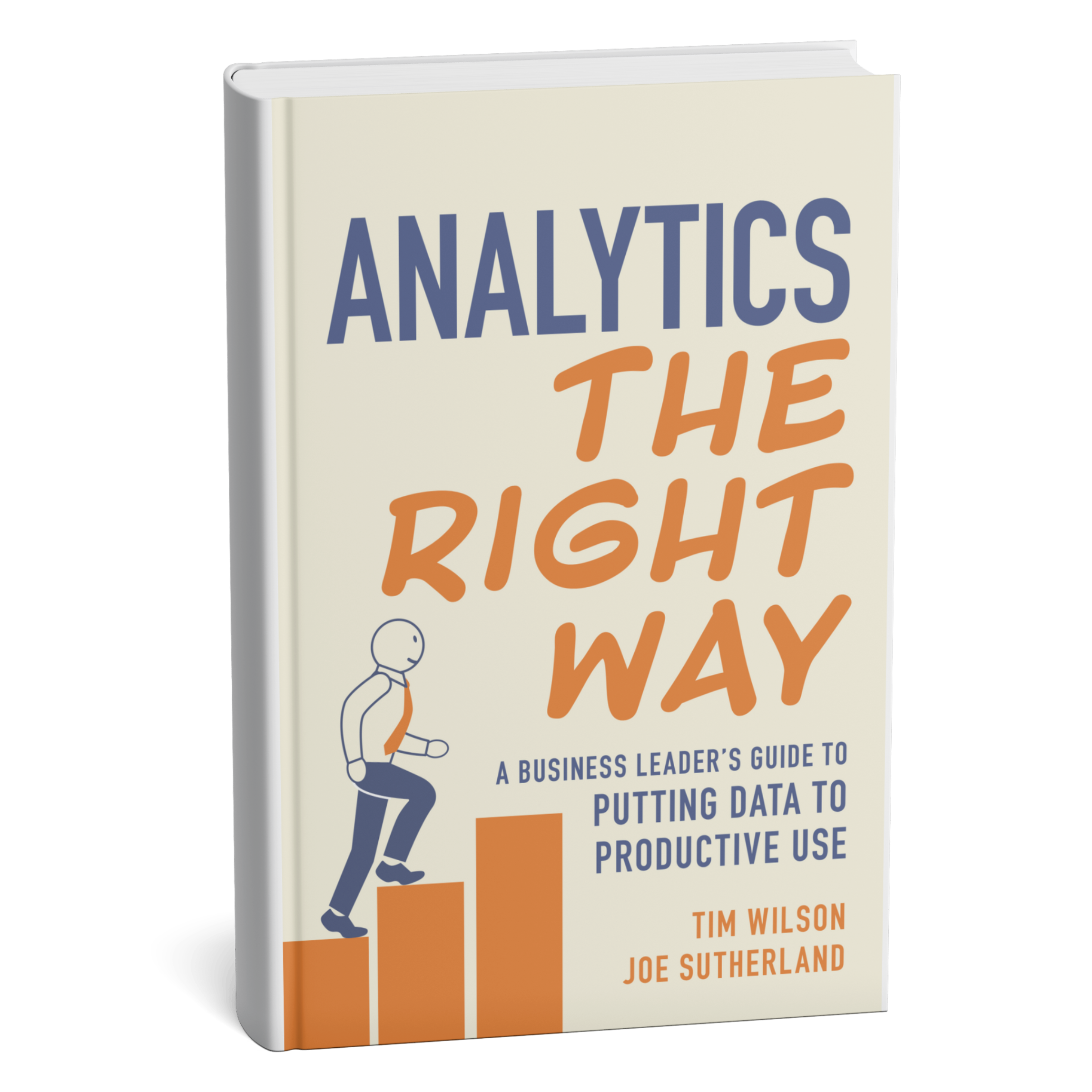
Book (Commercially published by Wiley)
Analytics the Right Way
A Business Leader's Guide to Putting Data to Productive Use
Tim Wilson, Joe Sutherland
A pragmatic guide for leaders who want a steady, manageable stream of decision-grade insight—not a deluge of dashboards, charts, and jargon.
Learn more at analyticstrw.comWhat executives get from it
- A clear operating language for 'So what?'—how data actually changes decisions.
- A practical structure for turning analytics into value, not noise.
- A decision-focused approach to causality and uncertainty (what you can and cannot conclude).
- A repeatable method to align leaders, analysts, and engineers around outcomes and constraints.
- A path to scale: from measurement to validated learning to operational enablement.
Why it matters in the AI era
AI amplifies the same enterprise problems that have limited analytics for years: unclear ROI, teams talking past each other, and vendor-driven narratives that confuse activity with value.
The fastest way to waste money is to treat AI like a collection of tools. The durable approach is to treat it like an operating system: define outcomes, measure performance, validate hypotheses, and embed capabilities into workflows—with governance that keeps speed high.
This book is the mental model behind how JL Sutherland & Associates runs AI value creation work: outcomes first, defensible execution, economic realism, and enablement.
Decision checklist
- Do we have a small set of business KPIs that data/AI is expected to move?
- Do we have a baseline today, and can we measure change credibly?
- Are we using data to measure performance, validate hypotheses, or enable operations (and which is it)?
- Can we distinguish correlation from decisions that actually change outcomes?
- Do teams share a common definition of success, failure, and uncertainty?
- Do we have a process to test claims from vendors, agencies, and internal teams early?
- Can we explain our ROI story without a 60-slide deck?
- Do we have governance proportional to risk (audit trail, controls, ownership)?
- Do we know what will make a pilot too expensive to scale (unit economics + integration)?
- Are we building capability so the organization can run this without permanent dependence?
Where to start
If you're the CEO
Common pains
- •You're funding data/AI, but the value story isn't decision-grade.
- •Teams ship activity (dashboards, pilots) without clear operational impact.
What you get
- A portfolio of initiatives tied to a short list of measurable outcomes.
- A decision cadence that separates signal from noise.
- Execution that scales without creating reputational risk.
If you're the CFO
Common pains
- •ROI claims are inconsistent; spend looks like a permanent tax.
- •AI costs (tokens + cloud + integration + review) are hard to govern.
What you get
- A measurement system you can trust (baseline → lift → unit economics).
- Defensible investment decisions without vendor capture.
- Cost discipline that preserves speed.
If you're the CIO
Common pains
- •Pilot sprawl: proofs-of-concept that don't survive production realities.
- •Governance either blocks shipping—or is missing entirely.
What you get
- A scalable operating model for analytics/AI (not tool-of-the-month).
- Governance that keeps speed high (auditability, controls, ownership).
- Enablement so teams adopt and improve the system over time.